
The situation: Mom comes home and chaos ensues
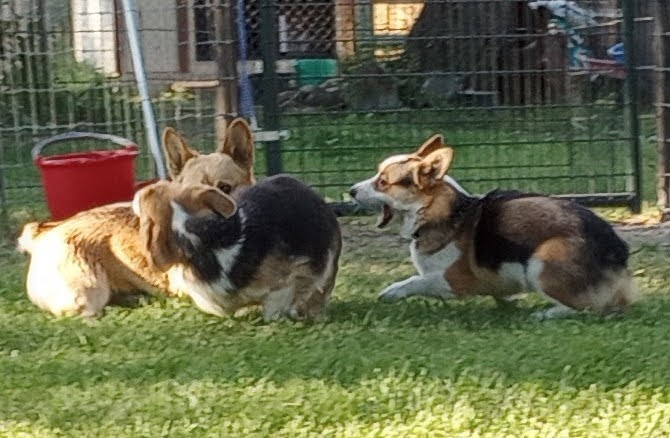
Today we are going to focus on a behavior I was recently asked about: A young dog that is obedient and pleasant until his (human) mom comes home. Everyone in the family is an adult, and there are other dogs in the house. It is harmonious until mom enters the scene. Freddy is mom’s dog. Once she comes home, he becomes difficult to manage, runs around wildly, barking and jumping on everyone, and becomes aggressive towards the other dogs in the house. How do we fix this situation?
Freddy is just a puppy and looking for his station in life. He may or may not be getting enough exercise. That is the first question I ask. How much exercise does Fred get? Fred is a corgi, so he’s in the middle of the energy spectrum. Minimally, two hours a day of focused activity keeps these guys satisfied. This activity should be at least one or two walks of 30 minutes or more, plus some other interaction that either challenges the brain or the body, or both. Fetching, frisbee, obstacle course, puzzles, hide and seek, obedience training, swimming, treadmill, grooming, play dates with other dogs, a trip to the dog park, herding — there are so many things you can do with your corgi to work their mind and body!
These exercises help eliminate agitation, stress, and physical energy. This in turn makes your dog satisfied and calm. Here is a very important word: Calm. What does a calm dog look like? They are laying quietly, sitting beside you without insisting on attention, not barking, and running around. They might yawn and lay down, their ears will be relaxed, their eyes are regular size and not bulging like they are going to pop out any second, their tail (or stub) isn’t going a million miles an hour.
A calm, relaxed, nonresistant dog can hear you when you ask them to do something, like sit or stay. They will pay attention while you teach them something new. They don’t exhibit energy from frustration or aggression. I cannot emphasize enough the need for all dogs to exercise. And I don’t want to burst anyone’s bubble but running around free playing in the back yard is absolutely not enough exercise. Yes, it’s nice for them to have that space to play and run when they want to, but there is no replacement for an in-hand deliberate and continuous walk.
The walk is the best time to show your leadership and prove your merited place of pack leader. I mean a real walk. Not a drag down the sidewalk or a pee and sniff fest. I mean walking beside you or behind you on a loose leash. Continuous, not stop and go. Just go. I will cover the walk in another talk soon, because the walk should be a union of the souls and melding of the minds and be ritual in its core. This is the most basic and yet most important activity you do with your canine companion because it touches them in the deepest prehistoric place in their brain and so commands their ever-present instinctual reactions.
So, we got this, right? Number one thing to help Freddy with his bad behavior is daily exercise with consistent leadership.
Next, mom must let Freddy know that she doesn’t approve of his behavior. How to stop the crazy barking jumping and running around wildly is to not greet him with excitement. In fact, don’t greet him at all. Don’t touch, don’t talk, don’t make eye contact when you walk in the door. Ignore him completely until he becomes calm. If you give affection while he is being crazy, you are telling him that you like him to run around being crazy. It’s hard to do, you’re happy to see him too, and you want to snuggle him and tell him how much you missed him, and he wants to tell you the same thing. But it creates energy that leads to behavioral problems. So don’t give him affection while he is out of control. Don’t give him affection at any time he is exhibiting behavior you don’t want him to do.
The number two thing to help Freddy is to never reward unwanted behavior.
Since Freddy is being aggressive with his canine roommates during this time, he should be leashed. Mom needs to be calm and confident and place herself between Freddy and the other dogs, then claim them as hers. She needs to let Freddy know that the other dogs are hers and she will not tolerate the dominance he is exhibiting over them. Other family members, also being calm and confident, can help by backing up Mom’s lead. Freddy needs to be taken to a state of calm compliance before the exercise is complete. If Mom goes only partway, say he is still running around but no longer going after the other dogs, and she stops there, then Freddy will continue responding in an excited dominate state of mind whenever Mom is home. She must take him all the way to calm compliance. This is by far the most difficult part because she must be patient and take as much time as it takes for Freddy to succeed, no matter how tired or busy she is (it’s hard, we understand!). Hopefully, because he is young and malleable, it will be quick and easy. But usually, the first 3 times will be the most difficult, and on day 3 he will act out the worst.
So, the number three thing to help Freddy is what? The patience and determination to get him all the way to calm!
Scene #1 Utter Chaos
Brother is in the study working on computer. Big, older Labrador is laying in the hall fast asleep. Sister is in the kitchen making dinner. Fred the corgi is in the living room staring out the window, tense, whining a little bit. Outside a car pulls up and Mom gets out, and suddenly the house erupts with loud barking and feet thudding as Fred leaps over the couch, down the hall, and nearly knocks Sister over because she was going out to help Mom with the groceries. Fred, in his heightened state of agitation comes across Labrador and immediately attempts to start a fight by snarling and barking and grabbing the bigger dog’s ears. Labrador cries and tries to get out of the way. His cries seem to encourage Fred and he now has hold of Labrador’s neck and won’t let go.
Now we are in the hall with two dogs brawling with each other. Mom opens the door into the hall with some groceries. Fred lets go of Labrador and charges to Mom, leaping on her and nearly knocking her down. Sister is yelling at Fred; Labrador is trying to leave in a hurry and now Brother shows up to help.
The house is in utter chaos. Freddy is charging around, back and forth between the front door and the kitchen, barking and leaping on random people. Everyone is yelling to be heard over the dog, and alternately yelling at Freddy to shut up. Twice more Fred nearly knocks mom down by running up to her and jumping up, or just body slamming himself into her legs. The lab wants in on the affection and reenters the hall. Suddenly Fred turns his very ramped up energy into fight energy, and once again attacks the Labrador. So at this point you get the scenario. Utter chaos.
Scene #2 How to stop what happened in scene #1
Step #1 Everyone is in their places: Brother is in study working on computer. Big, older Labrador is laying in the hall fast asleep. Sister is in the kitchen making dinner. Fred the corgi is in the living room staring out the window, tense, whining a little.
Outside a car pulls up and Mom gets out, and suddenly the house erupts with loud barking and feet thudding as Fred leaps over the couch, down the hall, and….
Finds Sister taking possession of the hallway by standing up straight and portraying a calm dominant woman that doesn’t allow dogs in her hall when they are in an agitated, aggressive state. Brother comes to help by also owning the hallway and the Labrador.

Mom waits in the car (she is older and standing out in the rain is not good).
Sister and Brother both block Fred’s every movement, demanding that he becomes calm and quiet by using an authoritative voice or using hands only. They might make a Shhht sound, snap their fingers, and say “hey!” or “no!” in an authoritative tone. They never yell and continue to maintain their calm dominant energy. Finally, Fred sits down and allows Brother to put a leash and collar on him. Using the leash and collar, Fred is kept at the spot where he was caught. He makes Fred sit using his voice, hand gestures, and leash to keep him in place. Brother isn’t overusing his verbal commands, but is relying primarily on his energy, leash, and hand gestures. (Often when I do this exercise I rarely talk to the dog. Most of the time, I use my hands to block his movement and small, sharp tugs on the leash when he begins to bark or leave the spot I have him sat down in.)
Meanwhile, Sister goes out to the car and gets Mom in. Freddy will try to explode, but brother must insist that he sit there quietly while mom gets in the door and finishes hauling in whatever is in the car. Freddy tries to bark, jump, pull back, chew on his leash, and charge forward. Brother is calm and assertive while stopping him from these actions by continuing to make him sit back down in place, and not allowing him to bark or be out of control.
You must have a leash and collar on to do this exercise. Harnesses, regardless of who made them or what they were supposed to be made for, are still a harness. And what is a harness used for? Think about it, the Budweiser horses are all in harnesses and what are they doing? Did someone in the crowd say PULLING? Yep, that’s the word! Harnesses are built for dogs to pull with too. Collars or head halters are for teaching and training your canine companion.
Freddy has finally become quiet. Exhausted by the experience, Fred remains quiet as Mom and Sister walk through the house and Mom settles in. Meanwhile, Brother allows Freddy to go to Mom, but she ignores him utterly until he sits down and becomes calm. When Freddy becomes calm and stays calm around Mom, the leash comes off and the exercise is over. This could take 30 minutes, and it might take all day, but I guarantee you that he will improve. That is your first step.
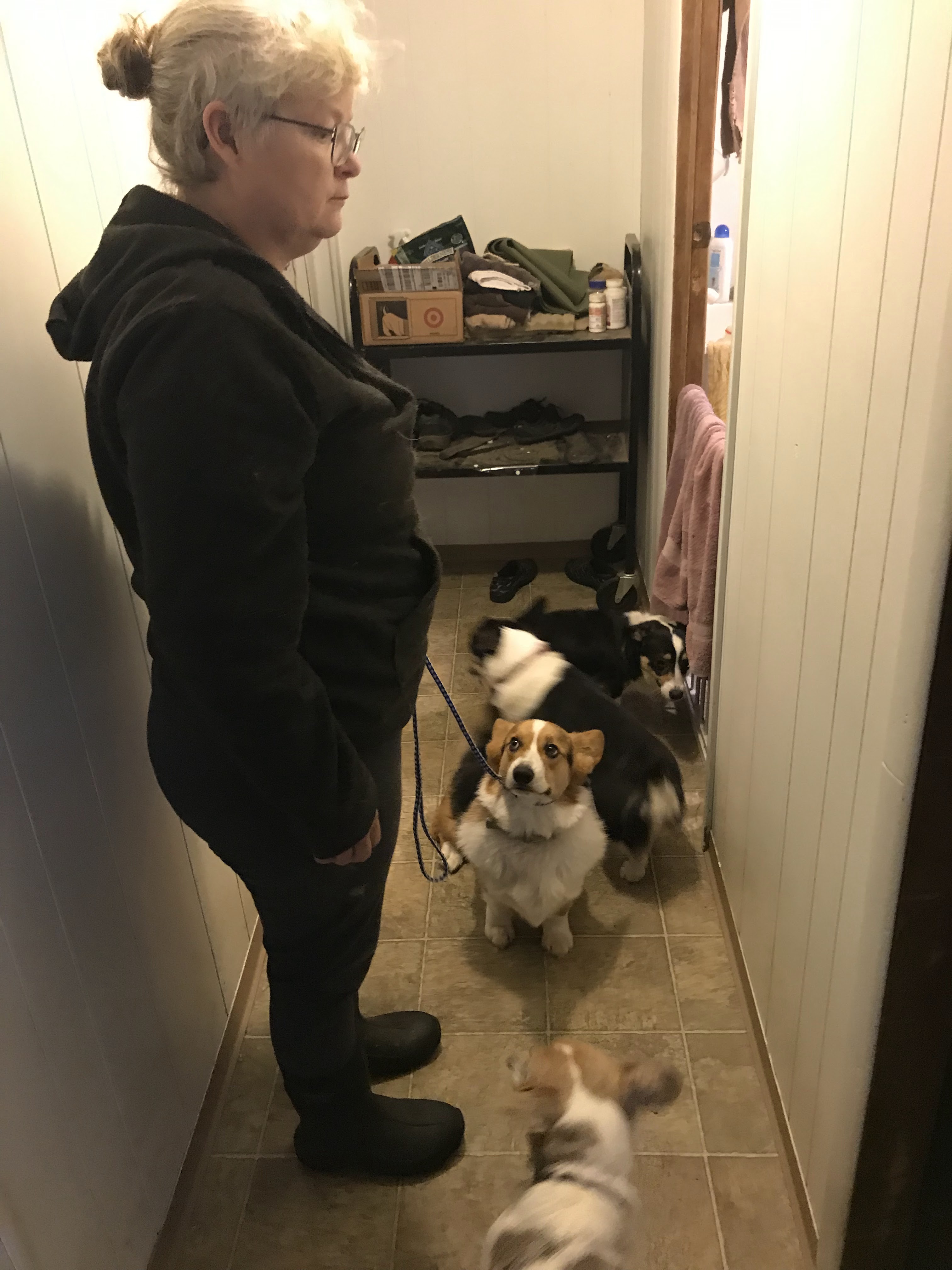
Everyone should always require Freddy to be calm before being fed, petted, taken for a walk, let out the door to go potty, etc. Mom must follow the rules also, she must make the corrections and follow through, otherwise Freddy will always be in control of the situation while Mom is around. Everyone must be consistent. Don’t share excited energy, don’t share aggressive energy. Always be calm confident with the dogs… and with people. There is more to this lesson, so don’t stay away. Come back soon and catch the next scene!
 Faery Mount Farm